


The Power of Imagination
Imagination is humanity’s oldest form of technology. Long before engines and algorithms, the human mind was already assembling worlds, bending time, rearranging symbols, and extending the borders of the possible. Across civilizations, this faculty was revered not as distraction but as a higher way of knowing. Ancient Taoists believed that the human spirit could “wander beyond,” stepping into unseen realms where intuition and creativity fused. West African griots preserved lineages of memory by infusing stories with metaphor until reality and invention became indistinguishable. And in the Islamic Golden Age, scholars described an “imaginal realm,” a space between matter and meaning that helped the soul perceive truths inaccessible to the senses.
At illi Collection, imagination is not an aesthetic flourish. It is the creative engine that anchors our work. When we began thinking about our Streetwear Collection, we did not begin with metal or sketches. We began with a person who did not exist and yet somehow did. We began with Lina Prata.

Lina Prata: The Fiction Who Reveals the Real
Lina Prata appeared to us as a boundary-pushing creative born in a hybrid city where tradition and technology constantly disrupt one another. Her last name, which means “silver” in Portuguese, seemed to arrive with its own logic, a quiet acknowledgment of the way she bends light and expectation wherever she moves.
She spent her childhood between underground skateparks and improvised digital art labs. She was a designer without formal training, a poet without an audience, a young activist who understood that style is sometimes a more subversive language than rhetoric. She was not interested in forecasting the future. She intended to build it.
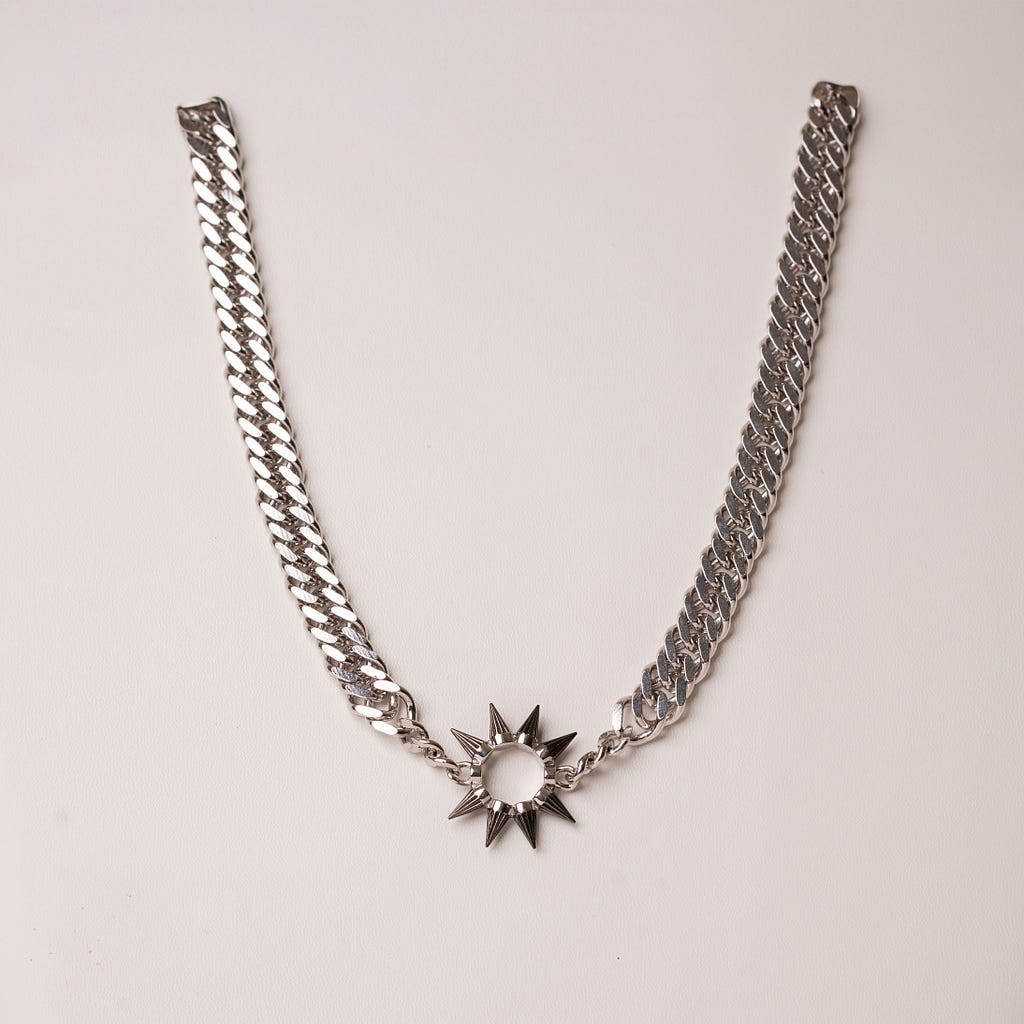
When we imagined Lina’s world, details began shaping themselves. Sharp lines, soft arcs, pieces that behaved like sketches distilled into metal. Some were aerodynamic, like the gentle pace of the Drift Necklace. Others carried the energy of a street mural rewritten in silver, as if cut from air, like the Slice Earrings. A few echoed the hum of an urban power grid, subtle and architectural, reminiscent of the Voltage Necklace. Even the gray-tinged understatement of the Neon Bracelet felt like extensions of her inner life.
The pieces did not imitate her; they revealed her. In imagining Lina, we discovered the collection that had been waiting all along.
The Spiritual Life of Imagination
Across cultures, imagination has been regarded as a spiritual faculty rather than a mental diversion. In Yoruba cosmology, creation unfolds across two realms: the visible world and the invisible one that shapes it. Imagination acts as the bridge between the two. Tibetan Buddhists use visualization not to escape the present but to enlarge it. A monk who imagines compassion repeatedly activates neural pathways until compassion becomes, in a neurological sense, a practiced reality.
Even in Western philosophy, imagination is not treated lightly. Kant believed it was the faculty that made human understanding possible. Coleridge called it the “sacred power” by which the mind harmonizes discord. These ideas, separated by continents and centuries, converge on a single insight. Imagination reveals truth by allowing us to inhabit a dimension not yet constrained by circumstance.
The Psychology of Possibility
Psychologists now understand what ancient cultures knew intuitively. Research from Stanford and the University of Pennsylvania shows that imagination expands problem-solving capacity, increases emotional resilience, and strengthens empathy. Through mental simulation, the brain experiences imagined scenarios in ways that resemble lived experience. This phenomenon reshapes motivation, makes abstract goals feel tangible, and softens fear by offering the mind rehearsal space.
Creativity, for this reason, is not frivolous. It is a psychological training ground. It cultivates flexibility, adaptability, and perspective. It allows adults to rediscover the imaginative elasticity that children possess naturally, which is precisely the quality needed in a world defined by rapid social and technological change.
Imagination as an Economic Force
Every economic shift has been preceded by imaginative daring. The wheel was once an improbable thought. The Silk Road, an audacious visualization of connection. The steam engine, the microchip, the blockchain, and the idea of flight were all, at their origin, acts of imagination.
In its Future of Jobs report, the World Economic Forum identifies creativity and imaginative thinking as two of the skills most essential for economic relevance in coming decades. The Adobe State of Create report notes that companies prioritizing creativity outperform their competitors significantly in revenue and market share. Economists describe imagination as the “innovation gap,” the crucial distance between what an industry currently is and what it could become.
For a brand, imagination becomes not just an advantage but a growth strategy. It shapes identity, informs authenticity, and anchors meaning. A competitor can replicate a product, but it cannot replicate the imaginative universe that births it.
Why Imagination Matters to illi
At illi Collection, imagination guides not only how we design but how we think about meaning. Jewelry is often treated as ornamentation. We treat it as language. A piece from our Streetwear Collection is not merely silver shaped into form. It is an artifact of a world built from imagination, a world where fiction serves clarity, where a character like Lina Prata embodies the freedom to invent oneself.
To imagine Lina is to imagine a future. To imagine a future is to make room for transformation. Every time someone wears a piece from the collection, they participate in that act of becoming. They carry forward the idea that imagination is not naïve. It is generative. It is sovereign. It is how humans continue to grow.
The Future Belongs to the Imaginative
Economies shift. Cities evolve. Technologies accelerate. Yet imagination remains the one resource that expands with use. Lina Prata may not exist in the archival sense, yet she occupies a place in our creative lineage as clearly as any historical figure. She is a reminder that fiction can be a form of truth and that imagination is one of the most powerful tools of self-invention.
To imagine is to open the door to everything that has not yet been lived. Every transformation begins with a simple question.
What if
Why not
What might be possible now
This is where all futures begin.